
Site Name: foundrylocal.ai
Category: Llm
Related Tags: # LLM # Url # Code # Text # Document
Website Link:https://www.foundrylocal.ai/
SEO Check Semrush Ahrefs Majestic
Visit SiteWebsite Description
Run AI models locally for private, low-latency on-device inference.
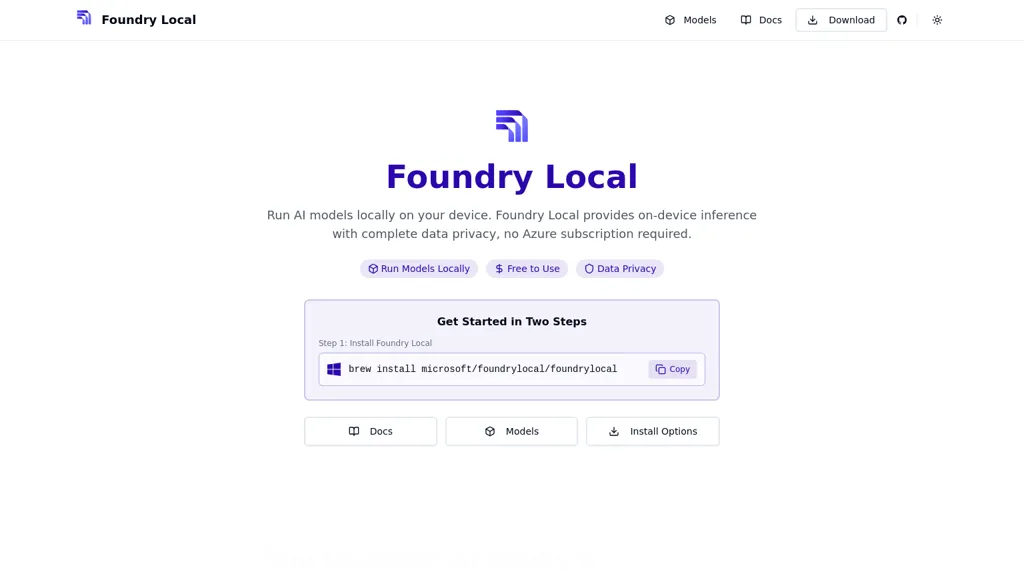
foundry local runs AI models locally with on-device inference to keep data on device and reduce cloud dependencies.Requires an Azure subscription and supports ONNX Runtime with CPU, GPU, and NPU hardware acceleration.
Provides an OpenAI-compatible API for integration with existing applications and developer workflows.Includes SDKs for Python, JavaScript, C#, and Rust plus a model hub with documentation and examples.
Targets developers, edge-device deployments, and enterprises needing data privacy, low-latency inference, and local control over models.Install via package managers (example: brew install microsoft/foundrylocal/foundrylocal) and run models with simple CLI commands (example: foundry model run qwen2.5-0.5b).Source code, releases, and community resources are available on GitHub; distributed under the MIT license.
View Statistics (Last 30 Days)
Similar Sites
Copyright www.sitelinkhub.com. Some Rights Reserved.


